Surface Rust (Corrosion) and Structural Implications of Reinforcement Steel

Reinforcement steel plays a critical role in reinforced concrete structures, directly influencing strength, load transfer, crack control, bond performance, and long-term durability. One commonly encountered condition during storage, handling, or prior to placement is surface rust on reinforcement steel. While often viewed as a defect, surface rust must be evaluated based on its structural relevance, rather than appearance alone.

Understanding the mechanism of corrosion, its effect on mechanical properties, and its impact on bond and durability is essential for making technically sound decisions on reinforcement usability-particularly in demanding construction environments.


Formation of Surface Rust on Reinforcing Steel

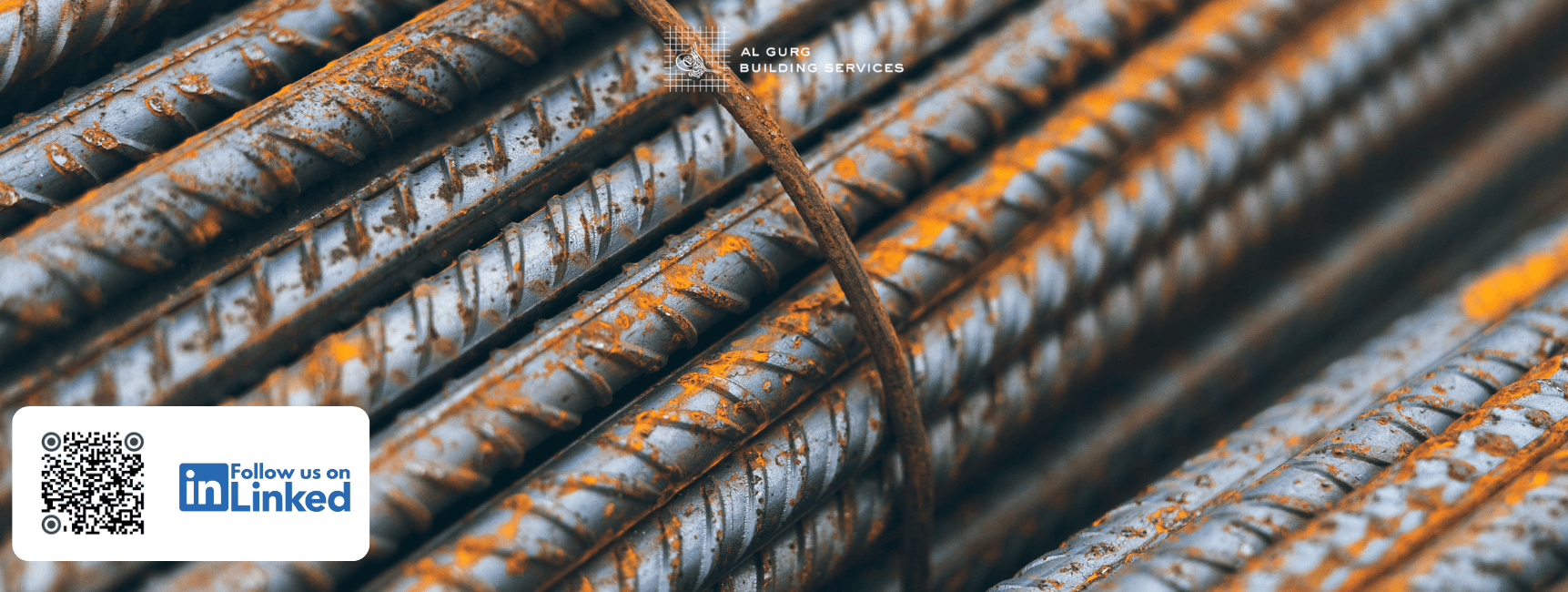
Surface rust forms when iron undergoes atmospheric corrosion in the presence of moisture. The rate and nature of this process are strongly influenced by environmental factors such as humidity, temperature, and pollution levels.

In oxygen-rich environments, corrosion typically produces red rust, which is the most commonly observed form on exposed reinforcement. In contrast, oxygen-poor conditions result in the formation of black rust. When chlorides are present, corrosion behaviour changes significantly. Rather than spreading uniformly, corrosion becomes localized, leading to pitting corrosion, which penetrates deeper into the steel and poses a higher structural risk.Shape


Effect of Corrosion on Mechanical Properties

The mechanical performance of reinforcing steel is closely tied to its cross-sectional area. When corrosion is light and uniformly distributed, its impact on mechanical properties is minimal. In such cases, the underlying steel retains its original strength, ductility, and toughness, provided there is no measurable reduction in bar diameter.

As corrosion progresses to a significant or advanced level, its effects become structurally relevant. Loss of cross-sectional area directly reduces the steel’s tensile strength and load-carrying capacity.

Corrosion also leads to reduced ductility, making the steel more brittle and less capable of undergoing deformation before failure. In chloride-rich environments, pitting corrosion further accelerates crack initiation and significantly reduces the life of reinforcement steel.


Effect of Rust on Bond Strength

Bond strength between concrete and reinforcement steel is fundamental to the performance of reinforced concrete structures. Light, uniform surface rust generally has little negative effect on bond strength and may even enhance bonding by increasing surface roughness and improving mechanical interlock.

As corrosion advances to a moderate level, the expanding rust layer generates internal pressure at the steel–concrete interface. This can lead to microcracking in the surrounding concrete and gradually weakening the bond.

In advanced corrosion stages, particularly where localized pitting occurs, bond performance deteriorates rapidly. Pitting reduces the effective bar diameter and weakens both the steel and its bond area. Once concrete cover cracking occurs or when corrosion products become flaky and non-adherent, bond strength drops sharply.


Effect of Rust on Durability

Reinforcement steel produced in good-quality, alkaline concrete (pH around 12) remains passive and corrodes very slowly, typically around 0.1 micrometers per year. This passive condition is maintained by the alkaline environment provided by the concrete.

Passivity can be disrupted when chlorides penetrate the concrete or when carbonation lowers the pH at the steel surface. However, in good-quality concrete where passive conditions are preserved, the presence of light surface rust on reinforcement does not increase corrosion rates and does not compromise long-term durability.


Acceptable Rust on Reinforcement

Most international standards do not define a strict quantitative limit for acceptable rust on reinforcement, as corrosion appearance alone does not reliably indicate structural performance. Instead, assessment is based on the principle of fitness for purpose.

According to CIRIA Report 147, acceptability of rust on reinforcement should be evaluated using five key criteria:

  • Bond strength with concrete
  • Remaining cross-sectional area of the bar
  • Impact on long-term durability
  • Mechanical acceptability of corrosion-related damage
  • Effect on appearance of exposed concrete surfaces

CIRIA Assessment Guidance
CIRIA recommends a structured evaluation approach to assess these criteria.

  • Reinforcement should be inspected for loose rust by rubbing the surface with a gloved hand. The presence of pitting should be carefully examined, as it indicates localized corrosion.
  • Loss of cross-section can be assessed by measuring weight reduction per unit length, while chemical contamination should be identified through laboratory analysis when required.
  • A final visual inspection confirms whether corrosion has resulted in mechanical damage affecting the reinforcement’s structural performance.

Remedial Treatment-CIRIA Recommendations
Where rust or scale is clean and adherent, no remedial treatment is required

  • If rust or scale is clean but loose, mechanical treatment or wet abrasive cleaning may be applied, followed by water-jet washing. In cases where rust or scale is contaminated, mechanical treatment is not recommended. Wet abrasive cleaning may be used, but washing should not be carried out.

At Al Gurg Building Services (AGBS), we specialized in manufacturing and supplying quality and compliant reinforcement steel products. Our products are produced strictly following stringent mechanical, dimensional, and performance specifications outlined in the standard.

Our reinforcement steel products such as welded fabric (welded wire mesh), reinforcement steel bar (rebar), and coils are delivered with uncompromised quality, compliance, and sustainability. We offer customized services and on-time delivery to ensure the reliability of our clients is kept well. Check our reinforcement steel products quality and access our catalogue:  Visit here

Understanding ASTM A615 Reinforcement Steel: Basics of Reinforcement Steel

Reinforcement steel is a fundamental component of reinforced concrete structures, directly influencing strength, load transfer, crack control, and long-term structural performance. Among globally recognised specifications, ASTM A615 is one of the most widely adopted standards for plain and deformed carbon-steel reinforcement bars, used extensively across infrastructure, residential, and commercial construction worldwide.

ASTM A615 remains a reliable and well-established reinforcement standard. However, a clear understanding of its mechanical behavior, deformation requirements, and application boundaries is essential-particularly in technically demanding environments such as the UAE.


What ASTM A615 Specifies?

ASTM A615 covers plain and deformed carbon-steel reinforcement bars manufactured in cut lengths or coils for use in concrete reinforcement. The standard is designed to ensure consistent and predictable structural performance by defining requirements related to:

  • Minimum yield and tensile strength
  • Elongation and ductility limits
  • Rib geometry and deformation patterns
  • Surface condition and finish
  • Permissible variation in weight and dimensions

These requirements ensure that reinforcement steel bars perform as intended when used in concrete.


Grades Defined in ASTM A615

ASTM A615/A615M, recognizes four minimum yield strength grades:

  • Grade 40: 280 MPa
  • Grade 60: 420 MPa
  • Grade 80: 550 MPa
  • Grade 100: 690 Mpa

Among these, Grade 60 remains commonly used globally due to its balanced strength and deformation characteristics. The inclusion of Grade 100 expands the standard applicability to higher-load structural elements, provided it is used in appropriate engineering limits.


Mechanical Behaviour and Ductility

ASTM A615 is a carbon-steel specification, and its mechanical behavior varies by grade.

  • Grades 40 and 60 offer well-balanced strength and deformation capacity suitable for a wide range of structural applications.
  • Grade 80 provides higher yield strength with controlled elongation characteristics.
  • Grade 100 delivers very high yield strength and includes specific requirements and notes addressing its reduced margin between yield and tensile strength.
  • ASTM A615 requires a minimum tensile-to-yield strength ratio of 1.10, helping prevent sudden rupture immediately after yielding.

Understanding these mechanical characteristics is essential for engineers working in environments where load intensity, temperature variation, and serviceability requirements are critical.


Deformation and Bond Performance

Bond performance between concrete and reinforcement steel is governed largely by bar deformation. ASTM A615 defines strict criteria for:

  • Rib height
  • Rib spacing
  • Rib angle
  • Part of circumference without ribs

These controls ensure effective anchorage, consistent load transfer, and reliable crack control.


Weldability Considerations

ASTM A615 does not include provisions intended to enhance weldability. Welding when required must be approached with care and follow recognized procedures in accordance with AWS D1.4 structural welding guidelines.

  • Controlled heat input and preheat practices
  • Approved filler materials
  • Consultant approval and documented procedures

Typical Applications of ASTM A615

ASTM A615 performs effectively in projects designed under ACI 318 and similar American-based design frameworks. It is commonly used in:

  • Residential and mid-rise buildings
  • Foundations and substructures
  • General reinforcement applications with moderate ductility demands
  • Structural systems that do not rely heavily on welded reinforcement

When supplied with proper certification, testing, and traceability, ASTM A615 continues to serve as a globally trusted and structurally dependable reinforcement solution.


At Al Gurg Building Services (AGBS), we specialized in manufacturing and supplying ASTM A615 plain and deformed reinforcement bars. Our products are produced strictly following stringent mechanical, dimensional, and performance specifications outlined in the standard.

Our reinforcement steel products such as welded fabric (welded wire mesh), reinforcement steel bar (rebar), and coils are delivered with uncompromised quality, compliance, and sustainability. We offer customized services and on-time delivery to ensure the reliability of our clients is kept well.

Check our reinforcement steel products quality and access our catalogue:  Visit here

  •  To know more about our reinforcement steel products, visit www.brcarabia.com/ or  request a callback
  • Want to read about ECAS Certification?, access our latest free eBook- “ECAS Guide eBook for reinforcement steel products by AGBS.”
  • Read more informative articles from AGBS Insights (Blogs) and don’t miss our next article by following us on LinkedIn  @Al Gurg Building Services.
How UAE Contractors Can Optimise Steel Usage Without Compromising Quality?

In today’s competitive construction market, efficient reinforcement steel management isn’t just good practice—it’s essential. Here’s how contractors in the UAE can optimise steel usage while upholding steel quality, compliance, and project safety.


1. Optimise Rebar Design & Detailing
• Effective steel optimisation begins during the design phase:
Utilise precise structural detailing and bar bending schedules (BBS) to minimise waste and over-ordering. Clear drawings reduce on-site confusion and over-cutting.
• Leverage software or parametric optimisation tools, such as equilibrium-based optimisation, to distribute reinforcement more efficiently and reduce material usage whilst ensuring structural resilience.

2. Minimise Cutting Waste with Smart Planning
Traditional rebar lengths and poor cutting lead to waste of up to 5% or more:
• Adopt special-length ordering and lap splice optimisation, or use mechanical couplers to greatly reduce cutting and scrap.
• Prior planning ensures minimal wastage and aligns with UAE’s sustainability goals.

3. Invest in Proper Storage & Handling
Protecting steel before installation is just as important:
• Store steel at least 150 mm above ground, ideally on racks, and shield against moisture, direct sun, and contamination.
• Ensure controlled environmental conditions in the yard and during transport to maintain steel integrity.

5. Embrace Sustainable and Circular Practices
Optimisation benefits both construction and environment:
• Reuse off cuts or damaged reinforcement steel as secondary products (e.g. nails), or return to recycling streams.
• Contractors can support UAE’s sustainability initiatives by reducing carbon footprint through reduced steel usage.
Frontiers

6. Prioritise Standard Compliance & Quality
Efficiency must never compromise safety:
• Use only certified reinforcement steel that meets standards like BS 4449:2005 + A3:2016 and is traceable via batch tracking. This preserves confidence and structural integrity.
• Accurate fabrication, bending, and cutting—following procedures and pre-heating where required—prevents material damage.


Putting It All Together: A Contractor’s Checklist:
▪︎ Detailed design & optimisation: Reduces over-ordering and material waste
▪︎ Planned cutting & couplers: Minimises scrap and shortens schedules
▪︎ Controlled storage: Prevents corrosion and preserves material quality
▪︎ Precise placement & tying: Avoids rework and ensures correct load bearing
▪︎ Sustainable recycling strategies: Cuts costs and lowers environmental footprint
▪︎ Certified quality & fabrication: Maintains structural performance and compliance


Why Steel Optimisation Matters in the UAE
▪︎ Cost Savings: Small reductions in steel waste translate into significant project savings.
▪︎ Faster Timelines: Efficient reuse and planning reduce downtime and delays.
▪︎ Regulatory Confidence: Following best practices supports inspection approvals by UAE authorities.
▪︎ Enhanced Reputation: Delivering structurally sound, compliant projects strengthens client trust.


Optimising steel usage isn’t just about trimming budgets—it’s a strategic discipline. By focusing on efficient detailing, smart cutting, proper storage, and stringent quality controls, UAE building contractors can deliver lean, safe, and environmentally responsible construction.

Need help with optimising reinforcement steel usage or sourcing certified reinforcement steel products?
Reach out to our AGBS team for expert support: Contact Us Now

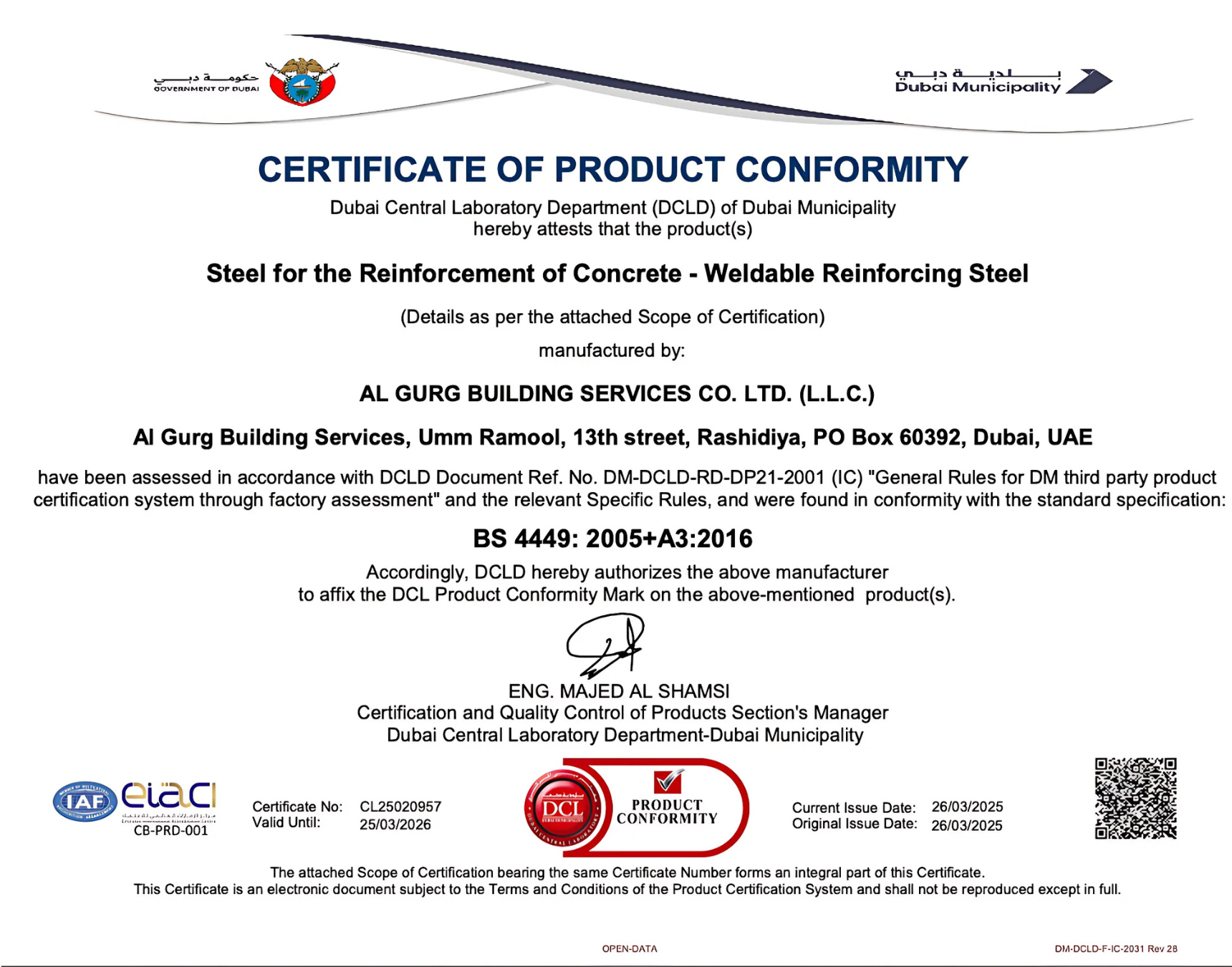
AGBS is Now DCL Certified

We’re proud to announce that Al Gurg Building Services (AGBS) is now DCL Certified by the Dubai Central Laboratory (DCL), a division of Dubai Municipality – for the production of reinforcement steel under the globally recognised
BS 4449:2005 + A3:2016 standard.

This milestone positions AGBS as the first cold drawn reinforcement steel producer in the UAE to achieve this certification, reinforcing our leadership in quality, compliance, and sustainable steel manufacturing.


What Does DCL Certification Mean?

The DCL Product Conformity Certification, issued by the Dubai Central Laboratory Department – Certification and Quality Control of Products Section, is one of the most trusted approvals in the UAE construction sector. It verifies that a manufacturer’s products meet all relevant local and international standards, particularly those aligned with Dubai Municipality’s regulations for safety, quality, and performance.

For reinforcement steel producers, DCL certification ensures that the steel used in infrastructure and buildings is:

  • Safe
  • Durable
  • Weldable
  • Compliant with project-specific technical requirements

AGBS’s DCL-Certified Reinforcement Steel

AGBS has acquired DCL certification for:
🔹 Products: Reinforcement steel bars, coils, and decoiled products
🔹 Standard: BS 4449:2005 + A3:2016 [ Steel for the reinforcement of concrete – Weldable reinforcing steel ]
🔹 Grade: B500B
🔹 Sizes: 6mm, 8mm, 10mm, and 12mm

With this certification, our reinforcement steel is now approved for all government, commercial, and private sector projects across the UAE.


Why This Certification Matters for Dubai Projects

DCL certification is often a mandatory requirement for construction projects across Dubai. For contractors and consultants, sourcing DCL-approved materials means:

  • Meeting regulatory compliance without compromise
  • Reducing risk of project delays due to material rejection
  • Ensuring long-term performance and safety

Now with DCL certification, AGBS’s clients can confidently integrate our steel into their builds knowing it meets the strictest technical benchmarks and sustainability goals.

Sustainability + Compliance = AGBS Advantage


What sets us apart isn’t just our certification – it’s how we earned it.

AGBS operates one of the most environmentally conscious reinforcement steel manufacturing setups in the region. Powered significantly by an in-house solar energy system, our production process has one of the lowest carbon footprints in the UAE steel industry. This achievement aligns with our ECAS Certification, further strengthening our compliance with both Emirates Authority for Standardization & Metrology and Dubai Municipality.

By combining technical compliance with sustainable operations, we deliver reinforcement steel that’s as responsible as it is reliable.


Build with Confidence – Partner with AGBS

Whether you’re planning infrastructure, towers, industrial facilities, or commercial spaces, you need certified and compliant steel you can trust.

🔗 Request a callback today to connect with our team and learn how our DCL-certified steel can meet your next project’s requirements.[Click Here]

🔗 Ready to Build Smarter, Stronger & Safer? Explore our full range of reinforcement steel products and discover why AGBS is the preferred choice for quality-driven contractors across the UAE. [ Click Here ]

🔗 Read more about how AGBS raised the bar by becoming the UAE’s first Cold Drawn Steel producer to acquire ECAS Certification,reinforcing our commitment to top-tier quality standards. [Click Here]