Reinforcement steel plays a critical role in reinforced concrete structures, directly influencing strength, load transfer, crack control, bond performance, and long-term durability. One commonly encountered condition during storage, handling, or prior to placement is surface rust on reinforcement steel. While often viewed as a defect, surface rust must be evaluated based on its structural relevance, rather than appearance alone.
Understanding the mechanism of corrosion, its effect on mechanical properties, and its impact on bond and durability is essential for making technically sound decisions on reinforcement usability-particularly in demanding construction environments.
Formation of Surface Rust on Reinforcing Steel
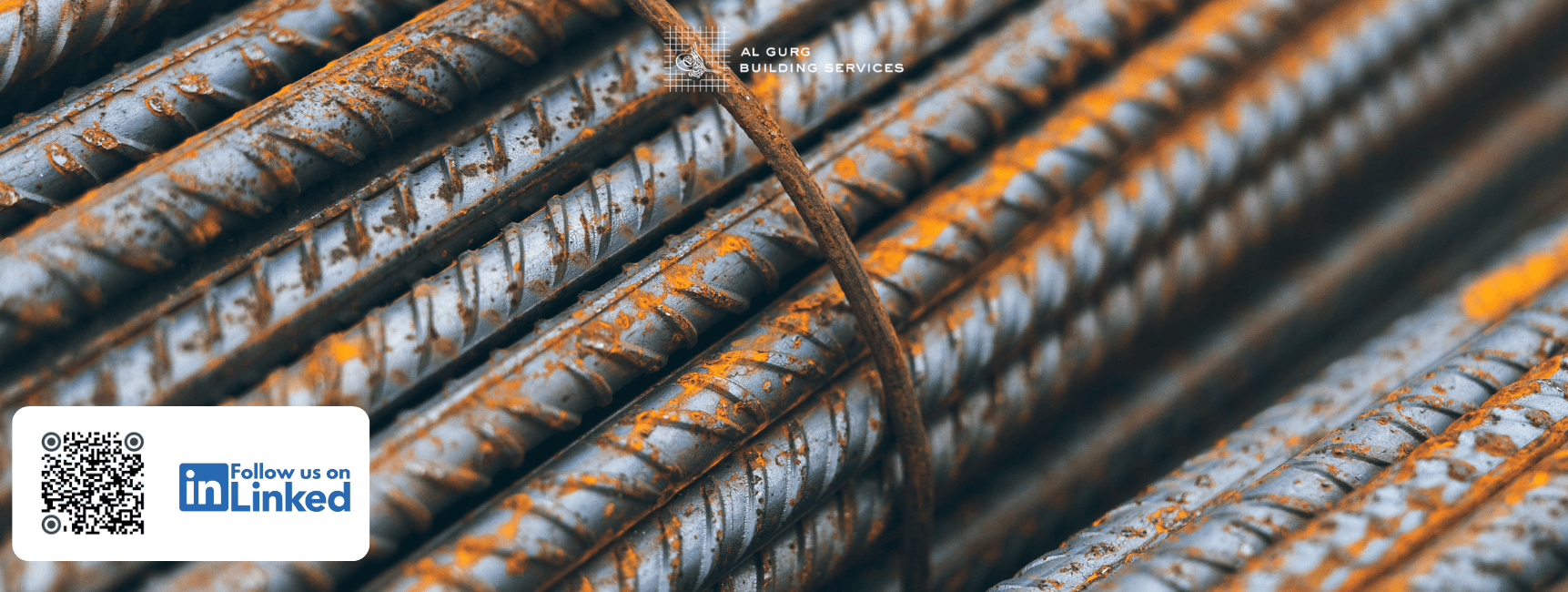
Surface rust forms when iron undergoes atmospheric corrosion in the presence of moisture. The rate and nature of this process are strongly influenced by environmental factors such as humidity, temperature, and pollution levels.
In oxygen-rich environments, corrosion typically produces red rust, which is the most commonly observed form on exposed reinforcement. In contrast, oxygen-poor conditions result in the formation of black rust. When chlorides are present, corrosion behaviour changes significantly. Rather than spreading uniformly, corrosion becomes localized, leading to pitting corrosion, which penetrates deeper into the steel and poses a higher structural risk.Shape
Effect of Corrosion on Mechanical Properties
The mechanical performance of reinforcing steel is closely tied to its cross-sectional area. When corrosion is light and uniformly distributed, its impact on mechanical properties is minimal. In such cases, the underlying steel retains its original strength, ductility, and toughness, provided there is no measurable reduction in bar diameter.
As corrosion progresses to a significant or advanced level, its effects become structurally relevant. Loss of cross-sectional area directly reduces the steel’s tensile strength and load-carrying capacity.
Corrosion also leads to reduced ductility, making the steel more brittle and less capable of undergoing deformation before failure. In chloride-rich environments, pitting corrosion further accelerates crack initiation and significantly reduces the life of reinforcement steel.
Effect of Rust on Bond Strength
Bond strength between concrete and reinforcement steel is fundamental to the performance of reinforced concrete structures. Light, uniform surface rust generally has little negative effect on bond strength and may even enhance bonding by increasing surface roughness and improving mechanical interlock.
As corrosion advances to a moderate level, the expanding rust layer generates internal pressure at the steel–concrete interface. This can lead to microcracking in the surrounding concrete and gradually weakening the bond.
In advanced corrosion stages, particularly where localized pitting occurs, bond performance deteriorates rapidly. Pitting reduces the effective bar diameter and weakens both the steel and its bond area. Once concrete cover cracking occurs or when corrosion products become flaky and non-adherent, bond strength drops sharply.
Effect of Rust on Durability
Reinforcement steel produced in good-quality, alkaline concrete (pH around 12) remains passive and corrodes very slowly, typically around 0.1 micrometers per year. This passive condition is maintained by the alkaline environment provided by the concrete.
Passivity can be disrupted when chlorides penetrate the concrete or when carbonation lowers the pH at the steel surface. However, in good-quality concrete where passive conditions are preserved, the presence of light surface rust on reinforcement does not increase corrosion rates and does not compromise long-term durability.
Acceptable Rust on Reinforcement
Most international standards do not define a strict quantitative limit for acceptable rust on reinforcement, as corrosion appearance alone does not reliably indicate structural performance. Instead, assessment is based on the principle of fitness for purpose.
According to CIRIA Report 147, acceptability of rust on reinforcement should be evaluated using five key criteria:
- Bond strength with concrete
- Remaining cross-sectional area of the bar
- Impact on long-term durability
- Mechanical acceptability of corrosion-related damage
- Effect on appearance of exposed concrete surfaces
CIRIA Assessment Guidance
CIRIA recommends a structured evaluation approach to assess these criteria.
- Reinforcement should be inspected for loose rust by rubbing the surface with a gloved hand. The presence of pitting should be carefully examined, as it indicates localized corrosion.
- Loss of cross-section can be assessed by measuring weight reduction per unit length, while chemical contamination should be identified through laboratory analysis when required.
- A final visual inspection confirms whether corrosion has resulted in mechanical damage affecting the reinforcement’s structural performance.
Remedial Treatment-CIRIA Recommendations
Where rust or scale is clean and adherent, no remedial treatment is required
- If rust or scale is clean but loose, mechanical treatment or wet abrasive cleaning may be applied, followed by water-jet washing. In cases where rust or scale is contaminated, mechanical treatment is not recommended. Wet abrasive cleaning may be used, but washing should not be carried out.
At Al Gurg Building Services (AGBS), we specialized in manufacturing and supplying quality and compliant reinforcement steel products. Our products are produced strictly following stringent mechanical, dimensional, and performance specifications outlined in the standard.
Our reinforcement steel products such as welded fabric (welded wire mesh), reinforcement steel bar (rebar), and coils are delivered with uncompromised quality, compliance, and sustainability. We offer customized services and on-time delivery to ensure the reliability of our clients is kept well. Check our reinforcement steel products quality and access our catalogue: Visit here
- To know more about our reinforcement steel products, visit www.brcarabia.com/ or request a callback
- Want to read more about ECAS Certification?, access our latest free eBook: “ECAS Guide eBook for reinforcement steel products by AGBS.”
- Read more informative articles from AGBS Insights (Blogs)and don’t miss our next article by following us on LinkedIn @Al Gurg Building Services.