Surface Rust (Corrosion) and Structural Implications of Reinforcement Steel

Reinforcement steel plays a critical role in reinforced concrete structures, directly influencing strength, load transfer, crack control, bond performance, and long-term durability. One commonly encountered condition during storage, handling, or prior to placement is surface rust on reinforcement steel. While often viewed as a defect, surface rust must be evaluated based on its structural relevance, rather than appearance alone.

Understanding the mechanism of corrosion, its effect on mechanical properties, and its impact on bond and durability is essential for making technically sound decisions on reinforcement usability-particularly in demanding construction environments.


Formation of Surface Rust on Reinforcing Steel

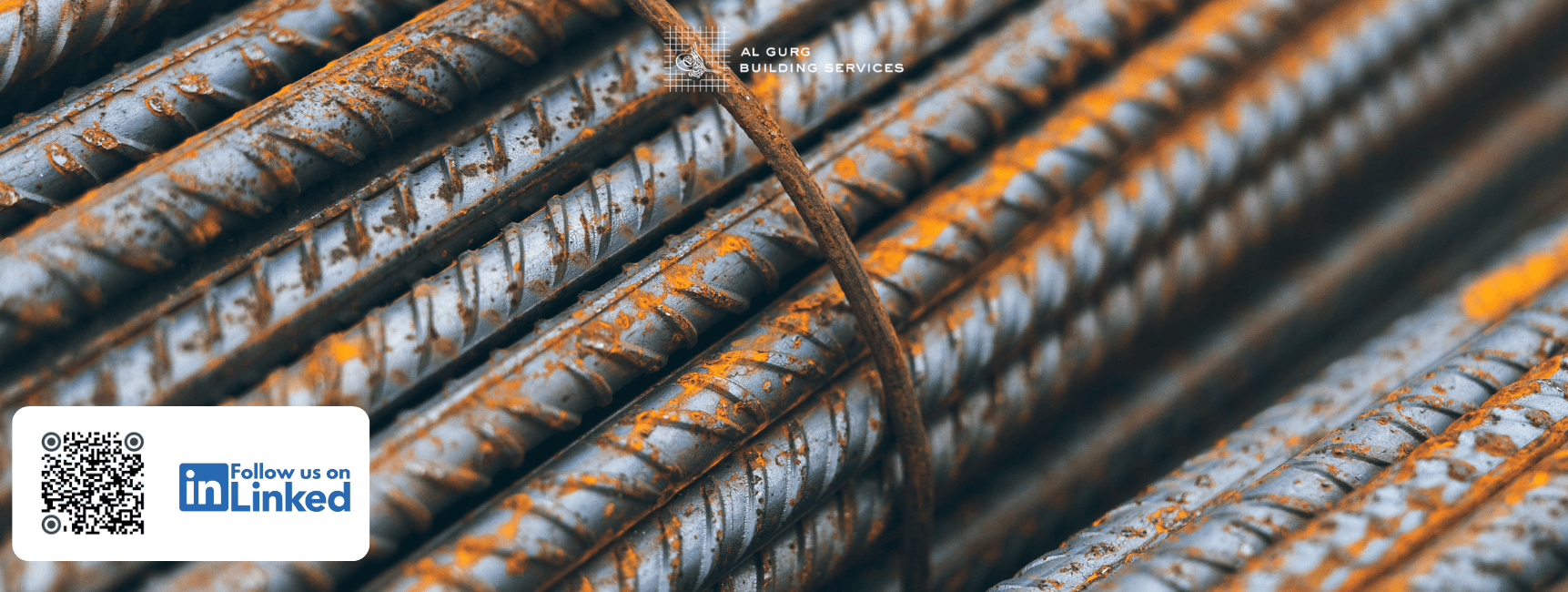
Surface rust forms when iron undergoes atmospheric corrosion in the presence of moisture. The rate and nature of this process are strongly influenced by environmental factors such as humidity, temperature, and pollution levels.

In oxygen-rich environments, corrosion typically produces red rust, which is the most commonly observed form on exposed reinforcement. In contrast, oxygen-poor conditions result in the formation of black rust. When chlorides are present, corrosion behaviour changes significantly. Rather than spreading uniformly, corrosion becomes localized, leading to pitting corrosion, which penetrates deeper into the steel and poses a higher structural risk.Shape


Effect of Corrosion on Mechanical Properties

The mechanical performance of reinforcing steel is closely tied to its cross-sectional area. When corrosion is light and uniformly distributed, its impact on mechanical properties is minimal. In such cases, the underlying steel retains its original strength, ductility, and toughness, provided there is no measurable reduction in bar diameter.

As corrosion progresses to a significant or advanced level, its effects become structurally relevant. Loss of cross-sectional area directly reduces the steel’s tensile strength and load-carrying capacity.

Corrosion also leads to reduced ductility, making the steel more brittle and less capable of undergoing deformation before failure. In chloride-rich environments, pitting corrosion further accelerates crack initiation and significantly reduces the life of reinforcement steel.


Effect of Rust on Bond Strength

Bond strength between concrete and reinforcement steel is fundamental to the performance of reinforced concrete structures. Light, uniform surface rust generally has little negative effect on bond strength and may even enhance bonding by increasing surface roughness and improving mechanical interlock.

As corrosion advances to a moderate level, the expanding rust layer generates internal pressure at the steel–concrete interface. This can lead to microcracking in the surrounding concrete and gradually weakening the bond.

In advanced corrosion stages, particularly where localized pitting occurs, bond performance deteriorates rapidly. Pitting reduces the effective bar diameter and weakens both the steel and its bond area. Once concrete cover cracking occurs or when corrosion products become flaky and non-adherent, bond strength drops sharply.


Effect of Rust on Durability

Reinforcement steel produced in good-quality, alkaline concrete (pH around 12) remains passive and corrodes very slowly, typically around 0.1 micrometers per year. This passive condition is maintained by the alkaline environment provided by the concrete.

Passivity can be disrupted when chlorides penetrate the concrete or when carbonation lowers the pH at the steel surface. However, in good-quality concrete where passive conditions are preserved, the presence of light surface rust on reinforcement does not increase corrosion rates and does not compromise long-term durability.


Acceptable Rust on Reinforcement

Most international standards do not define a strict quantitative limit for acceptable rust on reinforcement, as corrosion appearance alone does not reliably indicate structural performance. Instead, assessment is based on the principle of fitness for purpose.

According to CIRIA Report 147, acceptability of rust on reinforcement should be evaluated using five key criteria:

  • Bond strength with concrete
  • Remaining cross-sectional area of the bar
  • Impact on long-term durability
  • Mechanical acceptability of corrosion-related damage
  • Effect on appearance of exposed concrete surfaces

CIRIA Assessment Guidance
CIRIA recommends a structured evaluation approach to assess these criteria.

  • Reinforcement should be inspected for loose rust by rubbing the surface with a gloved hand. The presence of pitting should be carefully examined, as it indicates localized corrosion.
  • Loss of cross-section can be assessed by measuring weight reduction per unit length, while chemical contamination should be identified through laboratory analysis when required.
  • A final visual inspection confirms whether corrosion has resulted in mechanical damage affecting the reinforcement’s structural performance.

Remedial Treatment-CIRIA Recommendations
Where rust or scale is clean and adherent, no remedial treatment is required

  • If rust or scale is clean but loose, mechanical treatment or wet abrasive cleaning may be applied, followed by water-jet washing. In cases where rust or scale is contaminated, mechanical treatment is not recommended. Wet abrasive cleaning may be used, but washing should not be carried out.

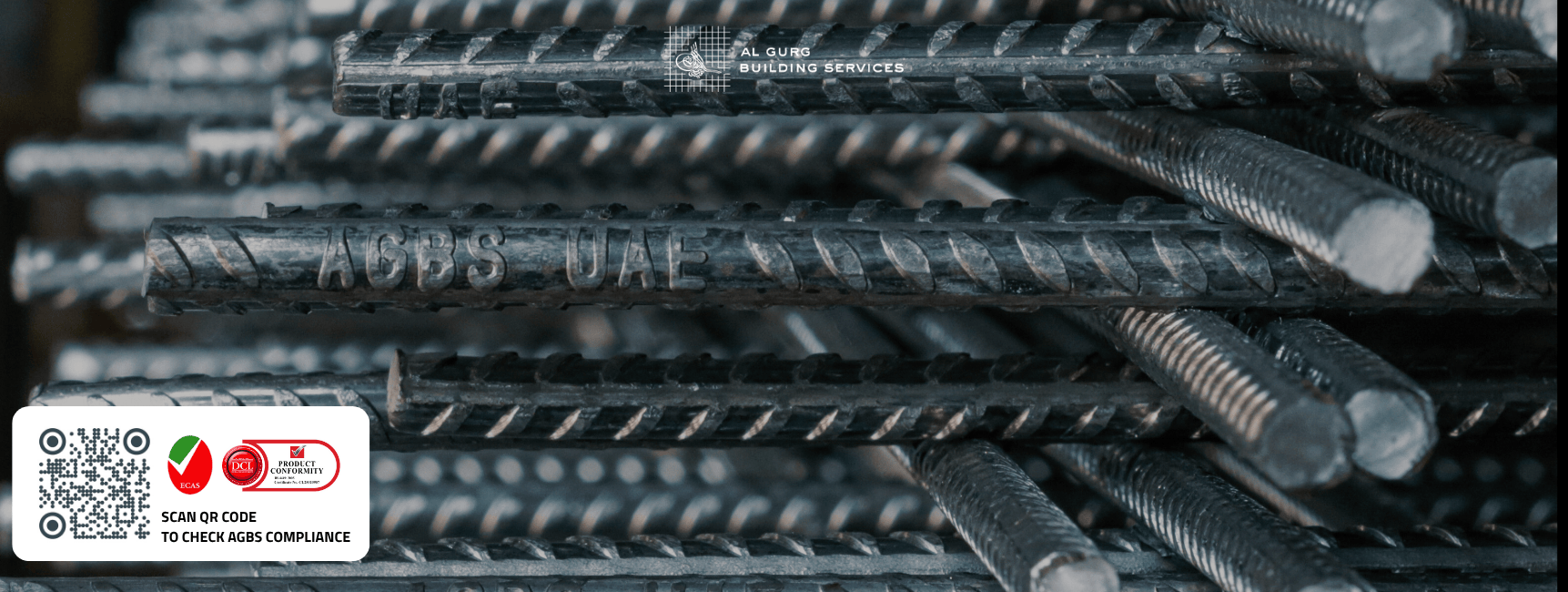
At Al Gurg Building Services (AGBS), we specialized in manufacturing and supplying quality and compliant reinforcement steel products. Our products are produced strictly following stringent mechanical, dimensional, and performance specifications outlined in the standard.

Our reinforcement steel products such as welded fabric (welded wire mesh), reinforcement steel bar (rebar), and coils are delivered with uncompromised quality, compliance, and sustainability. We offer customized services and on-time delivery to ensure the reliability of our clients is kept well. Check our reinforcement steel products quality and access our catalogue:  Visit here

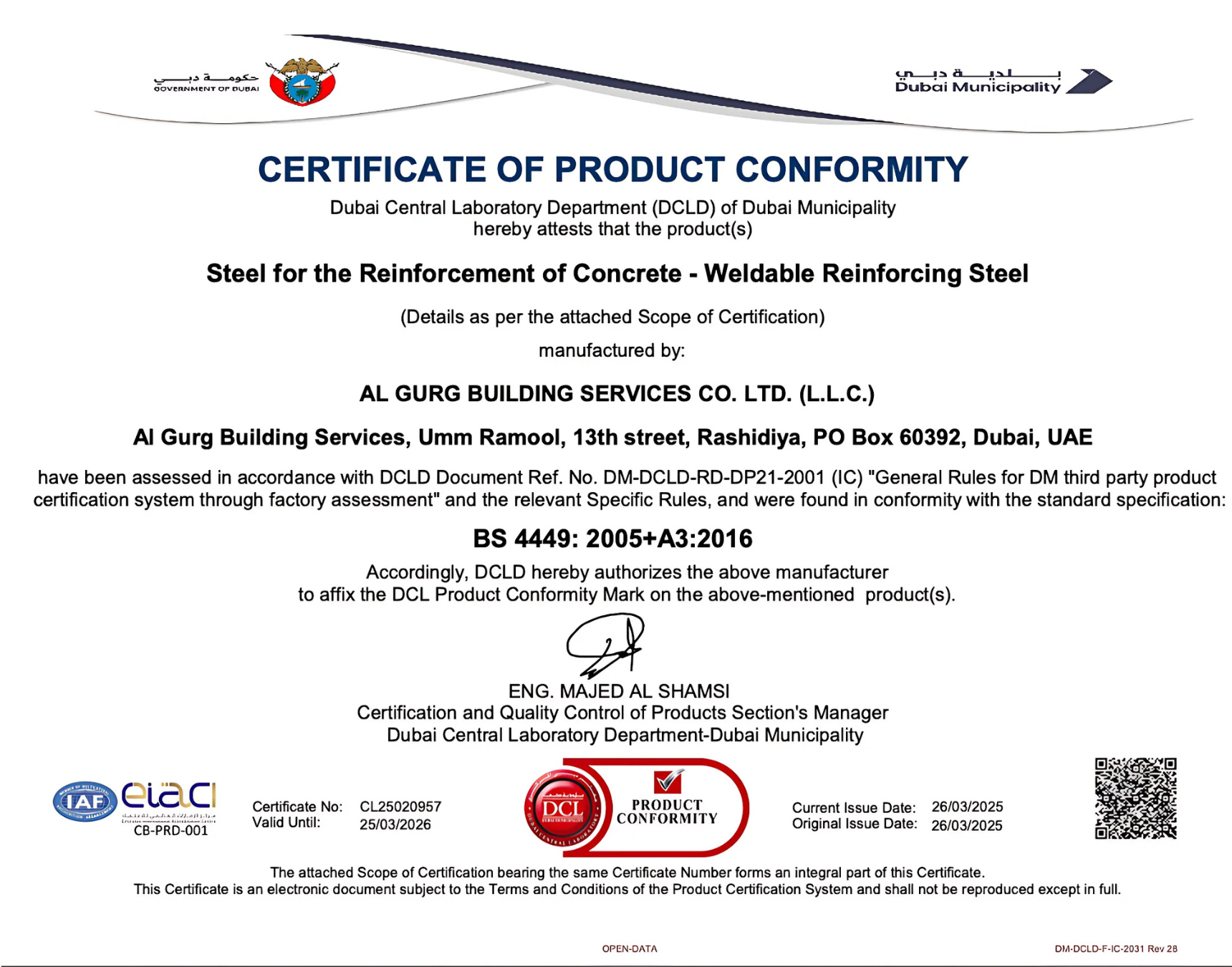
AGBS is Now DCL Certified

We’re proud to announce that Al Gurg Building Services (AGBS) is now DCL Certified by the Dubai Central Laboratory (DCL), a division of Dubai Municipality – for the production of reinforcement steel under the globally recognised
BS 4449:2005 + A3:2016 standard.

This milestone positions AGBS as the first cold drawn reinforcement steel producer in the UAE to achieve this certification, reinforcing our leadership in quality, compliance, and sustainable steel manufacturing.


What Does DCL Certification Mean?

The DCL Product Conformity Certification, issued by the Dubai Central Laboratory Department – Certification and Quality Control of Products Section, is one of the most trusted approvals in the UAE construction sector. It verifies that a manufacturer’s products meet all relevant local and international standards, particularly those aligned with Dubai Municipality’s regulations for safety, quality, and performance.

For reinforcement steel producers, DCL certification ensures that the steel used in infrastructure and buildings is:

  • Safe
  • Durable
  • Weldable
  • Compliant with project-specific technical requirements

AGBS’s DCL-Certified Reinforcement Steel

AGBS has acquired DCL certification for:
🔹 Products: Reinforcement steel bars, coils, and decoiled products
🔹 Standard: BS 4449:2005 + A3:2016 [ Steel for the reinforcement of concrete – Weldable reinforcing steel ]
🔹 Grade: B500B
🔹 Sizes: 6mm, 8mm, 10mm, and 12mm

With this certification, our reinforcement steel is now approved for all government, commercial, and private sector projects across the UAE.


Why This Certification Matters for Dubai Projects

DCL certification is often a mandatory requirement for construction projects across Dubai. For contractors and consultants, sourcing DCL-approved materials means:

  • Meeting regulatory compliance without compromise
  • Reducing risk of project delays due to material rejection
  • Ensuring long-term performance and safety

Now with DCL certification, AGBS’s clients can confidently integrate our steel into their builds knowing it meets the strictest technical benchmarks and sustainability goals.

Sustainability + Compliance = AGBS Advantage


What sets us apart isn’t just our certification – it’s how we earned it.

AGBS operates one of the most environmentally conscious reinforcement steel manufacturing setups in the region. Powered significantly by an in-house solar energy system, our production process has one of the lowest carbon footprints in the UAE steel industry. This achievement aligns with our ECAS Certification, further strengthening our compliance with both Emirates Authority for Standardization & Metrology and Dubai Municipality.

By combining technical compliance with sustainable operations, we deliver reinforcement steel that’s as responsible as it is reliable.


Build with Confidence – Partner with AGBS

Whether you’re planning infrastructure, towers, industrial facilities, or commercial spaces, you need certified and compliant steel you can trust.

🔗 Request a callback today to connect with our team and learn how our DCL-certified steel can meet your next project’s requirements.[Click Here]

🔗 Ready to Build Smarter, Stronger & Safer? Explore our full range of reinforcement steel products and discover why AGBS is the preferred choice for quality-driven contractors across the UAE. [ Click Here ]

🔗 Read more about how AGBS raised the bar by becoming the UAE’s first Cold Drawn Steel producer to acquire ECAS Certification,reinforcing our commitment to top-tier quality standards. [Click Here]

Types of Cold Drawn Compact Coils | Plain vs. Deformed – AGBS

In modern construction, Cold Drawn Compact Coils play a crucial role in enhancing durability. These steel coils are widely used in , spiral rings, and bar chairs in construction, making them an essential component for  For any type of  Reinforced Concrete construction

At AGBS, we provide two types of Cold Drawn Compact Coils to meet diverse project requirements:

  1. Plain Compact Coils
  2. Deformed Compact Coils

Both variants are designed to deliver superior performance, strength, and adaptability, ensuring optimal reinforcement for various construction applications.


What Are Cold Drawn Compact Coils?

Cold Drawn Compact Coils are produced by gradually reducing the diameter of plain wire rods through a cold rolling process. This process improves the tensile strength, forms the required surface pattern, and applies the needed marking. The wire is then straightened and cut to specific lengths, arranged as long and cross wires with required & acqurate spacing, and welded at the intersections using resistance welding to create a strong reinforcement mesh.

Key Features of Cold Drawn Compact Coils:

  • High tensile strength: Ideal for structural reinforcement.
  • Improved surface quality: Ensures better machinability and corrosion resistance.
  • Excellent dimensional accuracy: Provides uniformity and precision for construction needs.

Applications of Cold Drawn Compact Coils
Cold Drawn Compact Coils are extensively used in building construction due to their high strength and adaptability.
Where Are They Used?

  • Pre-Cast Concrete Manufacturing: Used in precast concrete slabs and beams to enhance strength.
  • Spiral Rings in Building Construction: Provides support and reinforcement in structural elements.
  • Bar Chairs in Construction: Helps maintain proper spacing between reinforcement steel and formwork.

These applications ensure that structures remain durable, well-supported, and resistant to heavy loads.


Types of Cold Drawn Compact Coils Available at AGBS

At AGBS, we supply two types of Cold Drawn Compact Coils, each designed to meet specific construction requirements.

1. Plain Cold Drawn Compact Coils

image

    • Smooth surface with no ridges or deformations.
    • Ideal for precision applications like spiral rings and bar chairs.
    • High flexibility makes it easy to shape and mold.
      🔗 Learn more: Plain Compact Coils


2. Deformed Compact Coils

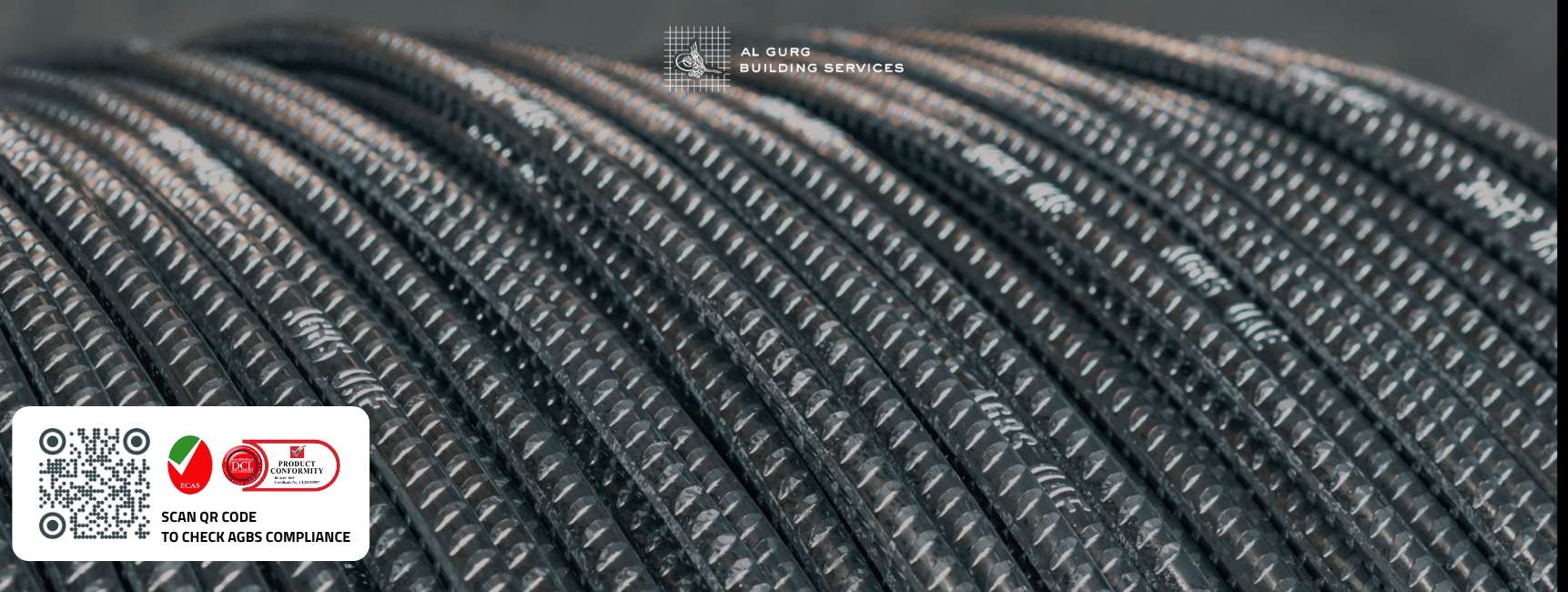
deformed compact coil

    • Ribbed surface enhances bonding with concrete.
    • Used in reinforced concrete structures for maximum stability.
    • Higher resistance to tension and structural loads.
      🔗 Learn more: Deformed Compact Coils


Cold Drawn Compact Coils are an essential component in modern construction, offering strength, durability, and versatility for various applications.

At AGBS, we supply high-quality Plain and Deformed Cold Drawn Compact Coils, ensuring that your construction projects meet the highest industry standards.


🔗 Contact us today for premium steel reinforcement solutions tailored to your needs!
🔗 Read more about Cold Drawn Compact Coils
🔗 Get expert guidance