
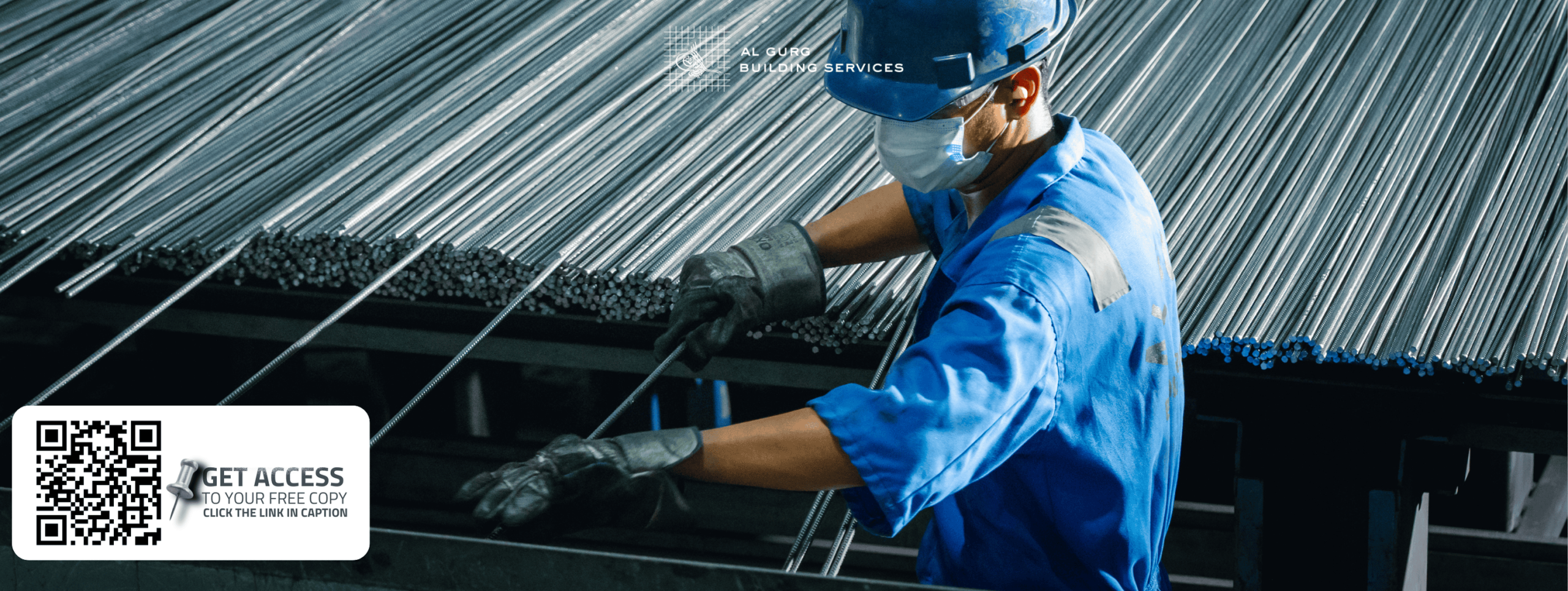
Understanding Reinforcement Steel Grade B500B | Basics Of Reinforcement Steel

Whether it is a villa, a multi-storey building, a bridge, or an industrial foundation, the safety of the structure depends heavily on the quality of the steel inside it. Among all the reinforcement grades used in the region, B500B is one of the most common and most reliable.


What Exactly Is B500B?
B500B is a high-strength steel bar used inside concrete. The “500” refers to its 500 MPa yield strength, which simply means it can handle high load before it starts to plasticaly deform. The first “B” means that this steel is used for reinforcing concrete while the later “B” represents its ductility class, meaning it is strong but also flexible enough to handle movement, temperature differences, and stress without breaking suddenly.

Under BS 4449:2005, B500B must meet the following characteristics:
• It must reach a yield strength of 500MPa (Characteristic Value)
• It must elongate at maximum force by 5% total elongation (Agt) before necking occurs.
• Its tensile strength must always be greater than its yield strength, ensuring that- its tensile-to-yield ratio is always at least 1.08.

This combination of strength and flexibility is why the UAE industry prefers it for most structural works.


Chemistry Behind B500B
For steel to be safe, weldable, and durable, its chemical composition is controlled. B500B limits the amount of carbon, sulphur, phosphorus, and other elements to ensure the bar can be welded on-site and can resist cracking. Under BS 4449:2005 Carbon is kept low (0.22% max), Sulphur and phosphorus are controlled to prevent brittleness, the carbon equivalent (CEV)-which shows how weldable the steel is-must be maximum 0.50% or lower. B500B is designed to be strong, safe, and easy to weld-all at the same time. This matters a lot in the UAE because most projects involve prefabricated steel, and on-site welding or mechanical couplers.


Specifications of B500B
• Strong enough for high-rises: The UAE’s skyline is full of towers-these structures demand steel that can take high loads. B500B’s 500 MPa strength gives engineers the safety margin they need.
• Reliable bonding with concrete: B500B bars come with controlled rib geometry (rib height, spacing, and angle) so they grip concrete tightly.
BS 4449:2005 gives exact ranges for these rib shapes to ensure proper bonding. This bond is what prevents concrete from slipping over the steel and losing strength.
• Proven fatigue resistance: The bars must survive 5 million cycles of stress in fatigue testing. This is important in bridges, metro lines, industrial plants, and structures that experience vibration

B500B is mostly used in:
• Columns, slabs, beams, and foundations in high-rise buildings
• Roads, bridges, flyovers, and tunnels
• Airport structures
• Warehouses and industrial plants
• Precast elements such as hollow-core slabs and beams
• Water tanks and retaining walls


It is a general-purpose, all-rounder steel grade suitable for most structural concrete applications. B500B reinforcement steel is trusted across the UAE because it strikes the perfect balance between strength and flexibility. It is strong enough to carry heavy loads, flexible enough to resist cracking, and weldable enough for practical on-site work.

At Al Gurg Building Services, Our team works closely with clients to provide tailored and compliant solutions that meet their project requirements without compromising quality. We are committed in manufacturing traceble, sustainable, and compliant reinforcement steel products.
Our ECAS and DCL-certified reinforcement steel products are welded fabric (welded wire mesh), reinforcement steel bars (rebars), and reinforcement steel coils.

Check our product quality and access our catalogue: Visit here
> To inquire our reinforcement steel products, visit www.brcarabia.com/. or request a callback
> Want to learn more about ECAS Certification?, access our latest free eBook-
“ECAS Guide eBook for reinforcement steel products by AGBS.”
> Read more informative articles from AGBS Insights (Blogs) and don’t miss our next article by following us on LinkedIn @Al Gurg Building Services.

Build with quality. Build with sustainability – Build with AGBS.
Corrosion in Reinforcement Steel Products: Acceptance & Non-Acceptance in the UAE- 

In the UAE, construction sites constantly face heat, humidity, dust, and coastal salt exposure. Because of this environment, reinforcement steel (rebar) may show surface discoloration during storage, transportation, or handling. But the question is,

Which discoloration is acceptable and which is a warning sign?

Understanding this helps ensure structures remain strong and safe for decades. At AGBS, we manufactured and handled reinforcement steel in line with UAE project requirements, helping customers avoid long-term durability issues from the start.


Why does discoloration happen?
Steel naturally reacts to its surroundings:

  • Humidity and rainfall
  • Coastal air with chloride exposure
  • Dust and airborne chemicals
  • Handling, storage, and transportation conditions

Even epoxy-coated and galvanized rebars can display slight shade changes due to production and curing variations. These color differences doesn’t mean the steel is damaged.

AGBS follows controlled & super-wised supply processes to protect bars from unnecessary exposure while ensuring compliance with UAE durability specifications.


Acceptable discoloration
Some types of discoloration do not harm the steel or the bonding with concrete.

  • Uniform light rusting:
    A thin, adherent, and uniform oxide film (light rust) that forms naturally during storage or handling is acceptable. This type of oxidation often increases surface roughness, enhancing the mechanical interlock and bond strength between steel and concrete.
  • Normal color variation in coatings:
    Epoxy-coated or galvanized bars may exhibit color variations (from light green to dark green for epoxy, or dull gray to shiny silver for zinc). These variations occur due to curing temperature differences, film thickness variation, or zinc oxidation stages, and are not indicative of coating failure as long as continuity and adhesion are maintained.
  • Handling marks and stains:
    Minor surface marks, scuffs, or dirt stains that do not penetrate the coating or oxide layer are acceptable. These superficial imperfections typically result from transport, bundling, or site handling and have no structural effect.
  • Galvanized bar white deposits:
    A soft, powdery white substance known as white rust (zinc hydroxide) can form on galvanized bars exposed to moisture during storage. This is a light zinc oxidation product and does not indicate deep corrosion unless it becomes compact, crusty, or associated with dark gray corrosion spots, which would suggest underlying steel exposure.

If discoloration or deposits can be removed by light brushing or wiping, leaving a sound surface underneath, the bar remains acceptable for use without additional cleaning or coating.


Non-Acceptable Discoloration
Some discoloration is a sign of serious corrosion. These must not be used in concrete unless repaired or replaced:

  • Heavy rust or scale formation:
    Deep reddish-brown rust with loose, flaky, or scaly texture indicates ongoing corrosion. This leads to sectional loss, reduction in effective diameter, and deterioration of mechanical properties (tensile strength and ductility).
  • Pitting corrosion:
    Localized pits or cavities represent anodic attack on the steel surface, leading to concentrated material loss and potential stress risers. Such bars may fail prematurely under load and must not be used.
  • Coating discontinuity or damage:
    For epoxy-coated or galvanized reinforcement, exposed bare steel, cracks in the coating are unacceptable. These defects allow accelerated corrosion under chloride or alkaline exposure and invalidate coating protection.
  • Surface contamination:
    Presence of oil, grease, lubricants, or paint residues interferes with the chemical adhesion between steel and cement paste. Any contaminant that reduces surface energy or prevents proper wetting of the bar surface renders the reinforcement non-compliant.
  • Chalking, blistering, or peeling of coatings:
    Such defects indicate UV degradation, chemical attack, or improper curing of protective layers. Loss of coating integrity exposes steel to environmental corrosion, disqualifying the bar unless re-coated and verified.

If discoloration shows deep damage, loose metal, or visible coating breaks, it is not acceptable. AGBS provides consistent quality assured reinforcement steel that comply with ECAS and DCL for international standards such as ISO and BS.


Why Is This So Important in the UAE?

Reinforcement steel is the main strength and support system inside every concrete element. It carries loads, absorbs stress, and keeps buildings safe for decades. When the steel surface is damaged (especially before concrete is poured) the issues may stay hidden at first, but they will eventually appear inside the structure, where maintenance becomes difficult and extremely costly.

In the UAE, structures are constantly exposed to harsh environmental conditions such as high humidity, marine salts, and aggressive chloride exposure-especially in coastal developments. Even small surface defects on reinforcement steel can rapidly turn into major durability problems once the building is in use.


If discoloration or corrosion is ignored at the start, it can lead to:

  • Weak bonding between concrete and reinforcement steel
  • Accelerated internal corrosion continuing after construction
  • Cracks, water leakage, and concrete spalling
  • Shorter service life and costly maintenance
  • Potential safety concerns over time

That’s why proper inspection and acceptance decisions at the construction stage are critical to ensuring the durability and safety of the UAE’s advanced infrastructure.


How you can evaluate discoloration?
On-site checks typically confirm:

  • Steel surface remains smooth
  • No deep rust or loose scale
  • Coating remains continuous with no exposed steel
  • Rust can be brushed off easily
  • Ribs/deformations remain clear and undamaged

Request supplier for compliance certificates such as ECAS / DCL product approvals in-order to evaluate the quality. As the first cold drawn steel producer to achieve ECAS and DCL certification in the UAE, we can proudly assist all our clients with the required documents which fasten their project approval proccess.

Not all discoloration is harmful-Choose the right steel to ensure long-term durability.


References

  • ASTM A615 / A615M – Standard Specification for Deformed and Plain Carbon-Steel Bars for Concrete Reinforcement, clause 12 Finish, sub clause 12.2
  • ASTM A767 / A767M – Standard Specification for Zinc-Coated (Galvanized) Steel Bars for Concrete Reinforcement, clause 6 Finish and Adherence of Coating
  • ASTM A775/A775M- Standard Specification for Epoxy-Coated Steel Reinforcing Bars, clause 8 Requirements for Coated Steel Reinforcing Bars

Build with quality. Build with sustainability – Build with AGBS.