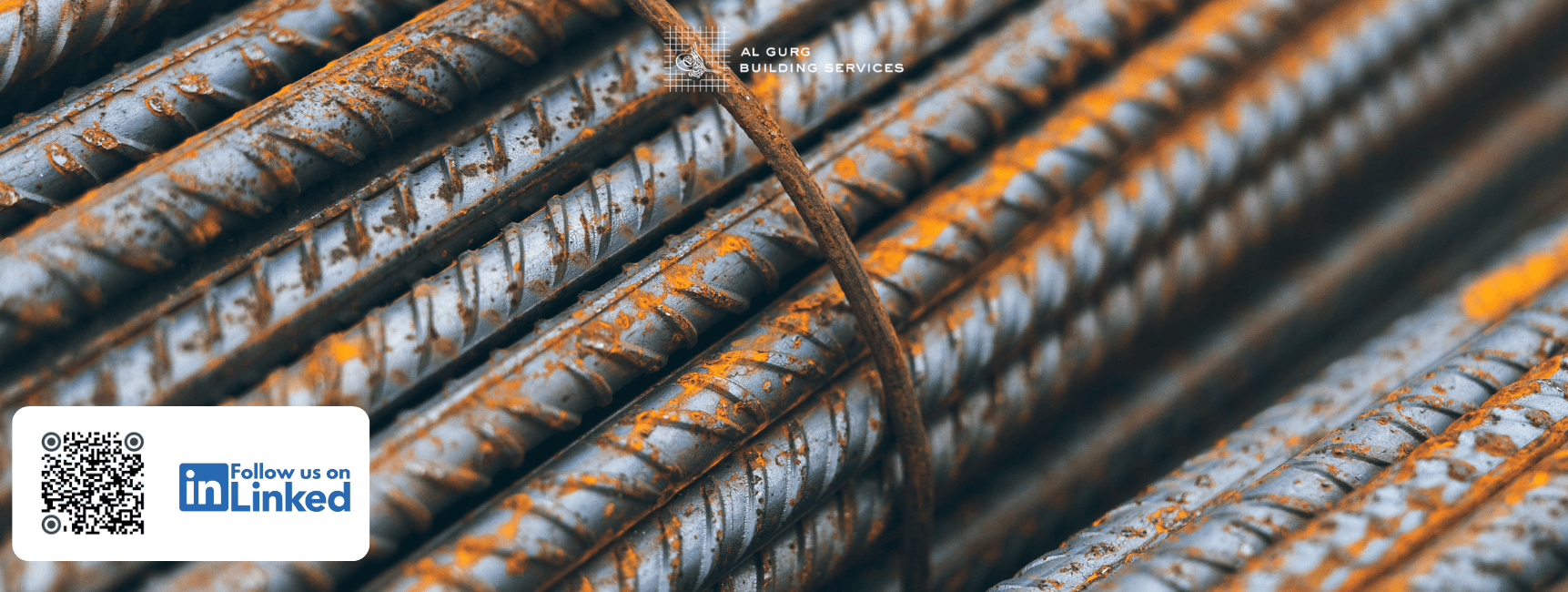
Surface Rust (Corrosion) and Structural Implications of Reinforcement Steel

Reinforcement steel plays a critical role in reinforced concrete structures, directly influencing strength, load transfer, crack control, bond performance, and long-term durability. One commonly encountered condition during storage, handling, or prior to placement is surface rust on reinforcement steel. While often viewed as a defect, surface rust must be evaluated based on its structural relevance, rather than appearance alone.

Understanding the mechanism of corrosion, its effect on mechanical properties, and its impact on bond and durability is essential for making technically sound decisions on reinforcement usability-particularly in demanding construction environments.


Formation of Surface Rust on Reinforcing Steel

Surface rust forms when iron undergoes atmospheric corrosion in the presence of moisture. The rate and nature of this process are strongly influenced by environmental factors such as humidity, temperature, and pollution levels.

In oxygen-rich environments, corrosion typically produces red rust, which is the most commonly observed form on exposed reinforcement. In contrast, oxygen-poor conditions result in the formation of black rust. When chlorides are present, corrosion behaviour changes significantly. Rather than spreading uniformly, corrosion becomes localized, leading to pitting corrosion, which penetrates deeper into the steel and poses a higher structural risk.Shape


Effect of Corrosion on Mechanical Properties

The mechanical performance of reinforcing steel is closely tied to its cross-sectional area. When corrosion is light and uniformly distributed, its impact on mechanical properties is minimal. In such cases, the underlying steel retains its original strength, ductility, and toughness, provided there is no measurable reduction in bar diameter.

As corrosion progresses to a significant or advanced level, its effects become structurally relevant. Loss of cross-sectional area directly reduces the steel’s tensile strength and load-carrying capacity.

Corrosion also leads to reduced ductility, making the steel more brittle and less capable of undergoing deformation before failure. In chloride-rich environments, pitting corrosion further accelerates crack initiation and significantly reduces the life of reinforcement steel.


Effect of Rust on Bond Strength

Bond strength between concrete and reinforcement steel is fundamental to the performance of reinforced concrete structures. Light, uniform surface rust generally has little negative effect on bond strength and may even enhance bonding by increasing surface roughness and improving mechanical interlock.

As corrosion advances to a moderate level, the expanding rust layer generates internal pressure at the steel–concrete interface. This can lead to microcracking in the surrounding concrete and gradually weakening the bond.

In advanced corrosion stages, particularly where localized pitting occurs, bond performance deteriorates rapidly. Pitting reduces the effective bar diameter and weakens both the steel and its bond area. Once concrete cover cracking occurs or when corrosion products become flaky and non-adherent, bond strength drops sharply.


Effect of Rust on Durability

Reinforcement steel produced in good-quality, alkaline concrete (pH around 12) remains passive and corrodes very slowly, typically around 0.1 micrometers per year. This passive condition is maintained by the alkaline environment provided by the concrete.

Passivity can be disrupted when chlorides penetrate the concrete or when carbonation lowers the pH at the steel surface. However, in good-quality concrete where passive conditions are preserved, the presence of light surface rust on reinforcement does not increase corrosion rates and does not compromise long-term durability.


Acceptable Rust on Reinforcement

Most international standards do not define a strict quantitative limit for acceptable rust on reinforcement, as corrosion appearance alone does not reliably indicate structural performance. Instead, assessment is based on the principle of fitness for purpose.

According to CIRIA Report 147, acceptability of rust on reinforcement should be evaluated using five key criteria:

  • Bond strength with concrete
  • Remaining cross-sectional area of the bar
  • Impact on long-term durability
  • Mechanical acceptability of corrosion-related damage
  • Effect on appearance of exposed concrete surfaces

CIRIA Assessment Guidance
CIRIA recommends a structured evaluation approach to assess these criteria.

  • Reinforcement should be inspected for loose rust by rubbing the surface with a gloved hand. The presence of pitting should be carefully examined, as it indicates localized corrosion.
  • Loss of cross-section can be assessed by measuring weight reduction per unit length, while chemical contamination should be identified through laboratory analysis when required.
  • A final visual inspection confirms whether corrosion has resulted in mechanical damage affecting the reinforcement’s structural performance.

Remedial Treatment-CIRIA Recommendations
Where rust or scale is clean and adherent, no remedial treatment is required

  • If rust or scale is clean but loose, mechanical treatment or wet abrasive cleaning may be applied, followed by water-jet washing. In cases where rust or scale is contaminated, mechanical treatment is not recommended. Wet abrasive cleaning may be used, but washing should not be carried out.

At Al Gurg Building Services (AGBS), we specialized in manufacturing and supplying quality and compliant reinforcement steel products. Our products are produced strictly following stringent mechanical, dimensional, and performance specifications outlined in the standard.

Our reinforcement steel products such as welded fabric (welded wire mesh), reinforcement steel bar (rebar), and coils are delivered with uncompromised quality, compliance, and sustainability. We offer customized services and on-time delivery to ensure the reliability of our clients is kept well. Check our reinforcement steel products quality and access our catalogue:  Visit here

Differences Between Plain Round Steel Bars & Deformed Rebars in Construction?

Steel is the backbone of modern construction, providing essential strength and stability to structures of all sizes. Among the various types of reinforcement steel products, Plain Round Steel Bars and Deformed Rebars are two primary options widely used across projects.
While they might seem similar at first glance, their differences play critical roles depending on the requirements.

In this blog, we break down the key differences between these two reinforcement options, helping you make the right choice for your construction needs.

1. Surface Characteristics
Round Steel Bars:
>
These bars have a smooth surface without any ridges or deformations.
>
Commonly referred to as “plain bars”.
>
They are typically used in lighter structural applications where high tensile bonding is not critical.

Deformed Rebars:
>
Deformed rebars have ribs, indentations, or projections rolled onto their surface during manufacturing.
>
These deformations provide high bond with concrete, significantly improving bond strength.
>
Ideal for critical applications like beams, reinforcing pre-cast concerete , columns, and slabs.

At AGBS, we manufacture high-quality ECAS and DCL Certified deformed reinforcement steel bars that meet international standards (BS 4449, ASTM A615, ISO 6935-2), ensuring superior concrete bonding and structural performance.

2. Mechanical Properties
Round Steel Bars:
>
Generally exhibit lower yield strength and lower tensile strength compared to deformed rebars.
>
Used where flexibility or lower stresses are acceptable.
Deformed Rebars:
>
Specifically manufactured to achieve higher yield strength and enhanced ductility.
>
Designed to resist greater tensile stresses and provide better reinforcement against structural loading.

3. Usage in Construction
Round Steel Bars:
>
Used in light structures, pavement slabs, railings, non-critical structures, and temporary works.
>
Suitable for situations where appearance or ease of bending and fabrication are priorities over tensile performance.
Deformed Rebars:
>
The standard reinforcement choice for Pre-cast, high-rise buildings, bridges, tunnels, foundations, and critical infrastructure.
>
Mandatory in almost all load-bearing concrete structures.

Why Choose AGBS?

At Al Gurg Building Services (AGBS), we pride ourselves on being one of the UAE’s first & leading DCL & ECAS certified manufacturers of cold drawn deformed reinforcement steel bars & coils. We also supply mild steel plain round bars.

Our commitment to quality, compliance, and customer satisfaction ensures that every bar produced supports safer, stronger, and more sustainable construction across the UAE. AGBS’s DCL and ECAS-certified deformed rebars and wide range of reinforcement steel products are commited deliver unmatched reliability and quality assurence.

📞 Contact us today and build with confidence

🏗️ Read about: Why Choose DCL Certified reinforcement steel products for Dubai projects

Why ECAS Certified Steel is Essential for Your UAE Projects?

In the UAE’s construction industry, ensuring the quality and compliance of materials is essential. The Emirates Conformity Assessment Scheme (ECAS), endorsed by the Ministry of Industry & Advanced Technology (MoIAT), is a mandatory certification that sets the benchmark for steel products used in construction projects. Governed under Cabinet Resolution No. 121/2023, ECAS certification guarantees that steel reinforcement products meet strict safety, durability, and environmental requirements.

For construction professionals, understanding ECAS is vital to ensure your projects adhere to national regulations and meet the highest standards for quality and sustainability. This guide breaks down ECAS certification, its key features, and how Al Gurg Building Services (AGBS) is leading the way with ECAS-certified products.


WHAT IS ECAS CERTIFICATION?
The Emirates Conformity Assessment Scheme (ECAS) is a regulatory framework designed to ensure that steel reinforcement products meet UAE-approved safety, quality, and environmental standards. ECAS certification is mandatory for manufacturers, importers, and suppliers of steel products used in the UAE’s construction sector.

Under Cabinet Resolution No. 121/2023, all carbon steel bars and billets used for concrete reinforcement must meet the following requirements to obtain ECAS certification:

  • Conformance with UAE-approved Standard Specifications (UAE.S)
  • Full traceability through static and dynamic QR codes
  • Compliance with environmental standards, including ISO 14001
  • Regular testing and audits to ensure ongoing compliance

Products without ECAS certification cannot be marketed or used in construction projects within the UAE.


KEY FEATURES OF ECAS CERTIFICATION
To meet ECAS standards, steel products undergo rigorous testing and verification. Below are the key features of ECAS certification:

  • MANDATORY COMPLIANCE: ECAS certification is a legal requirement in the UAE for all steel reinforcement products. Without this certification, materials cannot be marketed, sold, or used in construction projects.
  • COMPREHENSIVE TESTING: Steel products must pass several tests to ensure they meet the UAE’s safety and performance standards, including:

> MECHANICAL PROPERTIES TESTING: Products are tested for tensile strength, yield strength, and elongation to ensure they can withstand stress without failure.
> CHEMICAL COMPOSITION TESTING: Steel must meet strict limits for carbon, sulfur, and phosphorus to ensure durability and corrosion resistance.

  • FULL TRACEABILITY WITH QR CODES
    ECAS Certified products must include both static and dynamic QR codes to ensure full traceability throughout their lifecycle:

> STATIC QR CODE: Provides information about the product’s certification and manufacturer.
> DYNAMIC QR CODE: Offers detailed batch-specific data, including chemical composition, mechanical properties, batch numbers, and more.
This traceability helps construction professionals verify the authenticity and quality of the materials they use.

  • ENVIRONMENTAL RESPONSIBILITY: ECAS Certified products must comply with environmental standards, including the Environmental Management System (ISO 14001). Manufacturers must also provide an Environmental Product Declaration (EPD) to demonstrate their products’ sustainability.
  • REGULAR INSPECTIONS AND AUDITS: The Ministry of Industry & Advanced Technology (MoIAT) conducts annual inspections and audits to ensure ongoing compliance with ECAS standards. Products that fail to meet the standards may have their certification revoked.

WHY ECAS CERTIFICATION IS CRUCIAL FOR UAE CONSTRUCTION PROFESSIONALS
Understanding and using ECAS-certified steel products is essential for ensuring your construction projects comply with UAE regulations and maintain high standards for safety and performance. Here’s why it matters:

  • COMPLIANCE WITH UAE REGULATIONS: Under Decree 121/2023, using non-certified steel products in construction projects is illegal. By choosing ECAS Certified materials, construction professionals avoid legal penalties and ensure their projects meet national standards.
  • ASSURANCE OF QUALITY AND SAFETY: ECAS certification guarantees that steel products have been rigorously tested for strength, durability, and corrosion resistance. This is particularly important in the UAE, where structures must withstand extreme temperatures and harsh environmental conditions.
  • FULL TRACEABILITY: The inclusion of QR codes on certified steel products allows construction professionals to verify:
    Manufacturer name and location | Batch-specific chemical and mechanical properties | Compliance with UAE-approved specifications.
    This transparency ensures confidence in the materials used.
  • SUSTAINABILITY IN CONSTRUCTION: By meeting stringent environmental standards, ECAS Certified products contribute to greener construction practices, helping reduce the carbon footprint of projects.
  • LONG-TERM COST EFFICIENCY: High-quality materials certified under ECAS reduce the risk of structural failures, ensuring long-term durability and minimizing maintenance costs for developers and contractors.

HOW AGBS MEETS ECAS STANDARDS
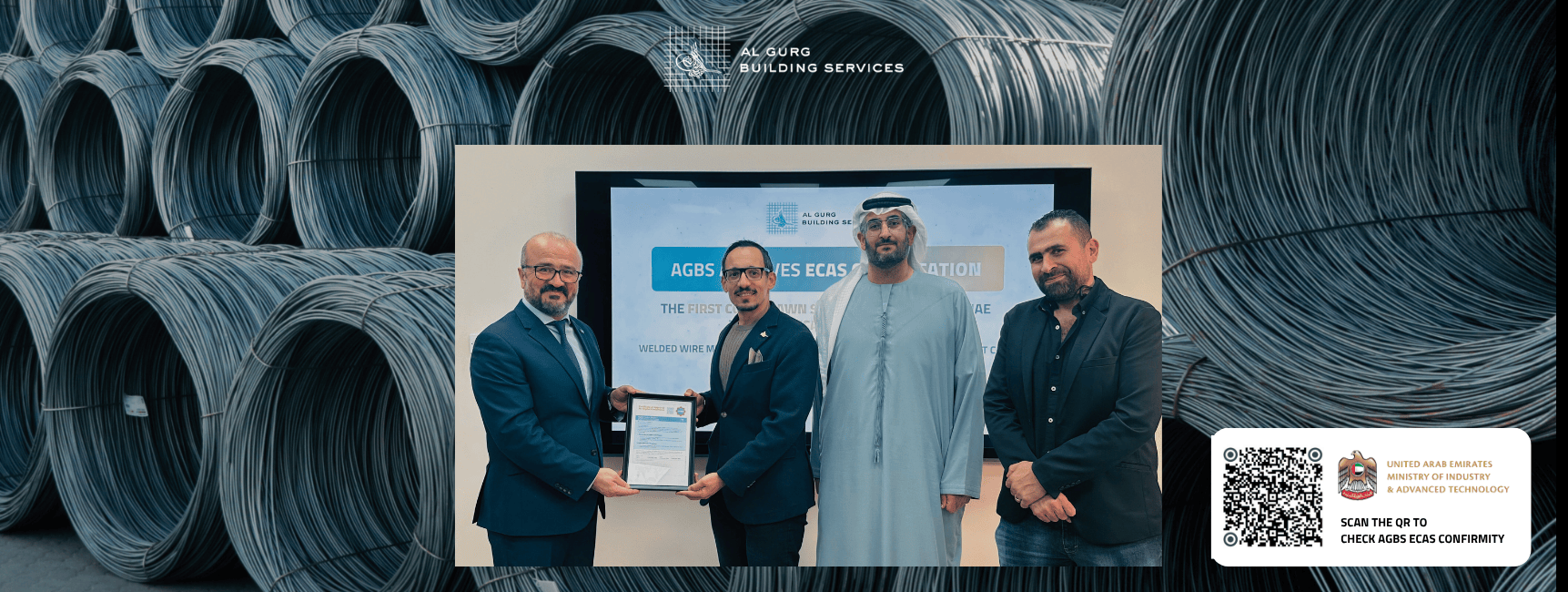
At Al Gurg Building Services (AGBS), we are proud to be the first cold-drawn steel producer in the UAE to achieve ECAS certification. This achievement highlights our commitment to delivering products that meet the highest standards for quality, safety, and sustainability. Our ECAS Certified products undergo comprehensive testing to ensure they comply with UAE laws and regulations.

OUR ECAS-CERTIFIED PRODUCTS


BUILD WITH CONFIDENCE USING AGBS ECAS-CERTIFIED STEEL
Choosing ECAS Certified products from Al Gurg Building Services (AGBS) ensures your construction projects meet the highest standards for quality, safety, and sustainability. Our products are fully traceable through QR codes, guaranteeing transparency and compliance at every stage of your project. For construction professionals, using ECAS-certified steel is more than a regulatory requirement, it’s a commitment to building stronger, safer, and more sustainable

Choosing ECAS-certified steel manufactures/producers like AGBS means you’re not just meeting regulations; you’re reflecting quality and assurance. You’ll build structures that stand the test of time, offering safety, durability, and compliance in every projects


🔗 Explore our ECAS Certified products
🔗 Contact us today and ensure safety and compliance for your upcoming projects in the UAE.
🔗 Read About | AGBS SET TO BE THE FIRST COLD DRAWN STEEL PRODUCER IN THE UAE TO ACQUIRE ECAS CERTIFICATION


SOURCES:

AGBS Achieves ECAS Certification

Excellence in construction, Another Milestone for Al Gurg Building Services (AGBS)

We are thrilled to announce that Al Gurg Building Services (AGBS) has officially achieved ECAS Certification from the UAE’s Ministry of Industry and Advanced Technology (MoIAT)!
This milestone is not just a mark of achievement, it’s a symbol of our unwavering commitment to quality, safety, and sustainability in the steel industry. As the first cold drawn steel producer in the UAE to achieve this certification, AGBS is setting a new benchmark for excellence. In a world where construction quality can’t be left to chance, ECAS Certification ensures our steel products meet the highest standards set by the UAE government, giving you materials you can trust and projects that stand the test of time.


WHAT IS ECAS CERTIFICATION?
The Emirates Conformity Assessment Scheme (ECAS) is a mandatory certification program for steel and construction products in the UAE. Developed by MoIAT, it ensures that all steel reinforcement products comply with Decree 121 of 2023, making ECAS approval a legal requirement. ECAS Certification guarantees that steel products meet essential standards for:

  • Quality: Products are rigorously tested to ensure they perform as expected.
  • Safety: Certified steel meets strict safety regulations, reducing the risk of structural failure.
  • Transparency: Each product comes with a Digital Product Passport (DPP) and Dynamic QR Code for instant traceability.
  • Sustainability: Compliance with ISO 14001 supports environmentally responsible construction practices.

Choosing ECAS-certified steel means you are using materials that are reliable, durable, and compliant with UAE regulations.


WHY ECAS CERTIFICATION MATTERS TO YOU?
In the construction industry, using the right materials is critical to the safety and success of your projects. Here’s why AGBS’s ECAS Certification matters for you:

  • Peace of mind: Our steel products meet the UAE’s strictest standards for safety and quality.
  • Full transparency: Access detailed product information via Digital Product Passports and Dynamic QR Codes.
  • Sustainability: Our certified products support green building practices and environmental responsibility.
  • Regulatory compliance: Under Decree 121 of 2023, all steel reinforcement products must be ECAS-approved. Using non-certified steel can result in penalties, project delays, and safety risks.

When you choose AGBS, you’re choosing a partner dedicated to trust, integrity, and excellence.


OUR COMMITMENT TO QUALITY AND INNOVATION
Achieving ECAS Certification is part of our ongoing mission to provide the construction industry with top-quality steel products. At AGBS, we believe that quality, safety, and trust should never be optional. This certification reinforces our dedication to:

  • Delivering reliable solutions: Steel products you can count on for strength and performance.
  • Building lasting relationships: Ensuring trust and transparency with our clients and partners.
  • Driving innovation: Continuously improving our processes and products to meet industry needs.

As the first cold drawn steel producer to achieve ECAS Certification, we are committed to raising the standards for the entire industry.


WHAT’S NEXT FOR AGBS?
Our journey doesn’t stop here. We’re excited to keep pushing boundaries and delivering ECAS-certified steel solutions that meet your project needs. We will continue to innovate, improve, and uphold the highest standards for quality, safety, and sustainability.
Explore our range of ECAS-certified products, including:

  • Welded Wire Mesh – ISO 6935-3:2023, Grade B500BWR (8 to 12mm)
  • Steel Reinforcement Coils – ISO 6935-2:2019, Grade B500BWR (8 to 12mm)
  • Steel Reinforcement Coils – ISO 6935-2:2019, Grade B500AWR (6mm)
  • Steel Reinforcement Bars – ISO 6935-2:2019, Grade B500BWR (8 to 12mm)
  • Steel Reinforcement Bars – ISO 6935-2:2019, Grade B500AWR (6mm)

🔗 Learn More About Our ECAS-Certified Products
🔗 Read more |
🔗 Contact Us Today & Ensure Compliance in Your UAE Projects.
🔗 Follow Our LinkedIn to Learn More About ECAS CERTIFICATION & MORE